Soluble boilies: how to make a fast-breakdown mix at home
In this guide
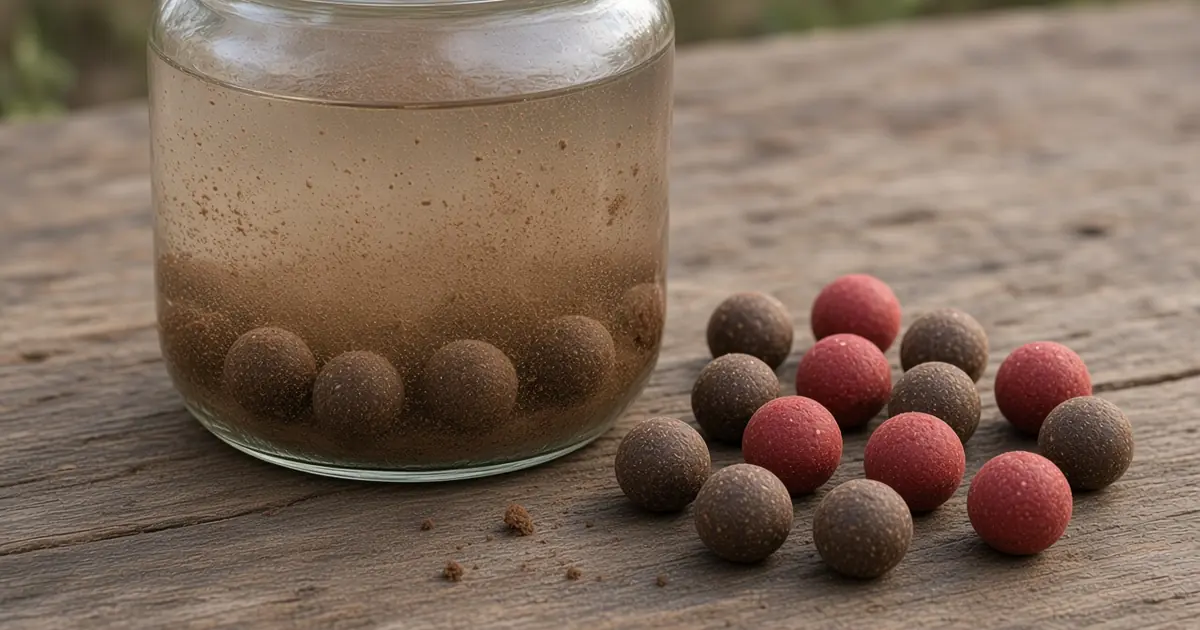
A soluble boilie is a bait that softens and falls apart in the water far quicker than a normal one. Instead of sitting on the bottom for days, it starts to crumble within hours and leaves a patch of broken bait and cloud behind. That makes it handy over a hard hookbait, in a PVA bag or as freebies for a short session, where you want the food gone and the smell out in the water.
You do not need special powders to make one. A soluble boilie is mostly a normal mix with the binders taken out, a few open ingredients put in and a shorter boil. Below is what makes a bait break down, which ingredients help and which slow it, plus a 1 kg recipe and a simple test you can do in a glass at home.
Key takeaways
- A bait breaks down fast when water can get into it easily and very little holds it together. Open ingredients help, binders do the opposite.
- Birdfood, breadcrumbs and maize meal open the texture. Milk powder, whey, sugar and CSL dissolve and leak out.
- Leave out wheat gluten, egg albumen and calcium caseinate, or keep them very low.
- Boil for a short time, around a minute for 15-18 mm baits, and use them fresh or frozen rather than air-dried.
- How fast a bait breaks down depends on your water, so test a few in a glass before you rely on them.
What makes a boilie soluble?
Every boilie starts to break down once it is in the water. Water soaks in, the soluble parts of the mix leak out, and the bait softens from the outside. A standard bait slows that down with a tight paste, binders and a proper boil, so it can sit on the lake bed for a day or more. A soluble bait does the reverse.
Four things decide how fast it goes:
- The mix. Coarse, open ingredients let water in. Fine flours and binders seal it out.
- The boil. The egg sets in the heat. The longer you boil, the tougher the skin.
- Drying. An air-dried bait has lost its water and gone hard, so it takes much longer to soften again.
- The water. Baits break down faster in warm water than in cold, and crayfish or small fish can pick them apart even quicker.
There is no fixed line between a soluble and a normal boilie. It is a scale, and you choose where your bait sits on it. If you have never rolled a batch before, start with our boilie recipe for beginners and come back once you know how a normal paste should feel.
Ingredients that speed up breakdown
These ingredients either open the texture so water gets in, or dissolve and leak out of the bait. The ranges are the usual amounts from the BoilieFormula ingredient library, given as a percentage of the dry mix.
Birdfood and breadcrumbs
Egg-biscuit birdfood is the backbone of most soluble mixes. It is crumbly, coarse and full of sugars and egg, and it gives a bait an open, almost cake-like inside. It usually sits at 5-30% of the mix. Breadcrumbs do a similar job for less money, normally at 5-25%. Both soak up a lot of liquid, so a mix with plenty of them needs more egg to roll.
Maize meal
Maize meal is a coarse filler that keeps the paste from getting dense. At 5-30% it adds bulk without adding much binding.
Milk powder, whey and sugar
Skimmed milk powder and sweet whey powder dissolve well in water, so they leak out quickly and help the bait soften. Keep milk powder around 3-15% and whey around 2-15%. Go higher and the paste turns sticky and hard to roll. A little sugar, usually 1-10%, dissolves fast and adds sweetness to the cloud.
CSL and betaine
CSL (corn steep liquor) is a liquid that goes in with the eggs. It is acidic, very soluble and leaks hard, and it also loosens the paste a little. A common starting point is 10-50 ml per kilo of dry mix. Betaine is weighed in grams, not percent: 1-5 g per kilo is plenty. Dissolve it in the eggs so it spreads through the whole batch.
What to leave out or cut back
A soluble mix is as much about what you take out as what you put in. These ingredients make a bait harder and slower to break down.
| Ingredient | What it does in a normal bait | In a soluble mix |
|---|---|---|
| Wheat gluten | Strong binder, gives a tough skin | Leave it out |
| Egg albumen powder | Sets hard when boiled | Leave it out |
| Calcium caseinate | Hardens and binds the bait | Leave it out or keep very low |
| Semolina | Binds and helps the paste roll | Keep a moderate amount so you can still roll |
Wheat gluten is the main one. Many recipes add 2-10% out of habit, and even a small amount noticeably slows the breakdown. Semolina is different: it binds a little, but you need some of it, otherwise the paste falls apart on the rolling table or in the pan. For more on what each part of a mix does, see our guide to boilie base mix ingredients.
A 1 kg soluble boilie recipe
This is a starting recipe for a birdfood-based soluble bait. Every amount sits inside the usual range for that ingredient. The weights are for the dry mix only.
| Ingredient | Amount (g) | Percentage | Purpose |
|---|---|---|---|
| Egg-biscuit birdfood | 300 | 30% | Open, crumbly base with a sweet, eggy smell |
| Breadcrumbs | 200 | 20% | Opens the texture and soaks up flavour |
| Semolina | 170 | 17% | Just enough binding to roll |
| Maize meal | 150 | 15% | Coarse bulk that keeps the paste light |
| Skimmed milk powder | 100 | 10% | Dissolves and leaks out |
| Sweet whey powder | 50 | 5% | Fast leakage and a milky cloud |
| Sugar | 30 | 3% | Sweetness that dissolves quickly |
| Total | 1000 | 100% |
Liquids for 1 kg of dry mix:
- 7 medium eggs (an eighth only if the paste is too dry)
- 25 ml CSL
- 2 g betaine, stirred into the eggs
There is no gluten, albumen or caseinate in it. You can open the free Birdfood Mix template in the calculator and change it towards these amounts to see the binding and nutrition for yourself.
How to make soluble boilies
- Weigh the dry ingredients and mix them well in a large bowl.
- Whisk the eggs with the CSL and betaine in a second bowl.
- Add the dry mix to the eggs a handful at a time and stir until it forms a paste.
- Leave it covered for 10-15 minutes. Birdfood and breadcrumbs keep soaking up liquid, so the paste firms up.
- Knead it. It should feel soft but not sticky. If it cracks when you roll a sausage, add a dash of water. If it sticks to your hands, work in a little more dry mix.
- Roll your baits. 15-18 mm is a good size to start.
- Boil small batches for around 60 seconds, timed from when the water comes back to the boil. For an even softer bait, try 45 seconds.
- Tip them onto a towel in a single layer and let them cool and dry off for a few hours.
Tip
Smaller baits break down faster. If you want a bait that is gone in a few hours, try 12-14 mm instead of 18 mm before you change the recipe.
The glass-of-water test
You do not have to guess how fast your baits break down. Drop three or four from the batch into a glass of water, ideally water from the lake you fish. Put a bait from your usual mix in a second glass so you can compare.
Check them after an hour, after three or four hours and the next morning. Give each one a gentle squeeze. A good soluble bait will be soft at the edges and clouding the water while the normal bait still feels firm. If yours is still hard the next day, shorten the boil or cut the semolina a little. If it falls apart within minutes, add a bit more semolina or boil a little longer.
Keep in mind that a glass on the kitchen table is usually warmer than the lake. In cold water the same bait will take longer, which is also why soluble baits are a handy option in winter. Our guide to winter boilies covers that side of it.
Drying and storing soluble baits
Soluble baits are best used fresh or frozen. Let them dry on a towel for a few hours until the skin feels dry, then bag and freeze them, or keep them in the fridge if you are using them within a day or two.
Warning
Do not air-dry soluble baits for days like a shelf-life bait. They go hard, and a hard bait takes much longer to break down, which defeats the point. Damp baits kept in a sealed bag at room temperature can also go mouldy within days.
When soluble boilies make sense
Soluble baits work best where you want the food to go quickly and leave scent and small particles behind, for example:
- short day sessions where you will not be there for baits to soften on their own
- in a PVA bag or stringer next to a harder hookbait
- crushed and spodded to make a cloudy patch
- topping up a spot with a few baits rather than a big bed
They are a poor choice as a hookbait. Use a harder bait on the hair, for example from your normal mix boiled for longer, and keep the soluble ones as freebies. If you have Pro, the High-Leakage Mix on the templates page is a Pro template built for fast leakage that you can use as another starting point.
Note
In waters with lots of crayfish, bream or small roach, soft baits can be eaten or picked apart fast. That is not always bad, since activity can pull carp in, but the baits will not last long. Watch how quickly your spot is cleared and adjust.
Common mistakes
- Adding gluten out of habit. It is in so many recipes that it slips in. Leave it out for a soluble mix.
- Too much milk powder or whey. The paste gets sticky and hard to roll. Stay inside the usual ranges.
- Too few eggs. Birdfood and breadcrumbs drink a lot of liquid. A dry paste cracks and breaks up in the pan.
- Boiling for the normal two minutes. That gives you a normal bait. Keep it short.
- Air-drying them. Fresh or frozen keeps them soluble.
- Changing too much at once. Change one thing per batch so you know what made the difference.
Checklist before you roll
- No gluten, albumen or caseinate in the mix
- Birdfood, breadcrumbs or maize meal for an open texture
- Milk powder and whey inside their usual ranges
- Dry mix adds up to 1000 g and 100%
- Eggs, CSL and betaine weighed separately
- Boil time set at around 60 seconds or less
- A few baits ready for the glass test
- Bags ready for the freezer
How BoilieFormula can help
Changing a mix by hand gets messy fast, especially when you take the binders out. In the free boilie calculator you can build your soluble mix in grams or percent and see the binding, nutrition and cost per kilo change as you go. It also warns you when the liquid or an ingredient looks too high. The free plan gives you unlimited calculations, three saved recipes, basic nutrition, the balance score and warnings, cost per kilo and the full ingredient library.
If you test a lot of versions, the Pro plan adds unlimited saves, detailed scores, recipe comparisons and versions, a testing journal to note how each batch did in the glass and on the bank, custom ingredients, extra templates and print or export.
Frequently asked questions
How long does a soluble boilie take to break down?
It depends on the mix, the boil, the size of the bait and above all the water temperature. A soft, freshly boiled bait in warm water can start falling apart within a few hours, while in cold water the same bait can last much longer. Do the glass test with water from your lake to get an idea.
Can I turn any boilie recipe into a soluble one?
Mostly, yes. Take out the gluten and albumen, swap some of the fine flour for birdfood or breadcrumbs and boil for a shorter time. Very oily or fishmeal-heavy mixes stay tighter, so you may need more open ingredients.
Can I use a soluble boilie as a hookbait?
It is not a good idea. It will soften and can come off the hair. Use a harder bait on the hook and the soluble ones around it.
Can I freeze soluble boilies?
Yes, that is the best way to keep them. Let them dry on a towel for a few hours first so they do not freeze into one lump.
Are soluble boilies good in winter?
They can be. In cold water every bait breaks down more slowly, so a soluble mix helps get some scent out. Use small amounts and test them in cold water first.
Final thoughts
A soluble boilie is not a different kind of bait, just a normal mix pushed towards open ingredients, no binders and a short boil. Start with the recipe above, test a few in a glass, and change one thing at a time until the breakdown suits the way you fish. Note what you changed and how the baits behaved, so the next batch is easier.