Boilie base mix ingredients explained: what each one does and how much to use
In this guide
A boilie base mix is the dry part of the bait, and every ingredient in it has a job. Some give the carp a food signal, some set the texture, some hold the bait together and a few are there purely for attraction. Once you know which ingredient does which job, and roughly how much of it to use, you can build your own mix or fix someone else's recipe instead of copying a bag off the shelf.
This guide goes through the main base mix ingredients group by group, with the amounts most people start with, then shows how to balance them in a 1 kg test mix. There is no single perfect mix. These are starting points you adjust on your own water.
Key takeaways
- Fishmeal, milk proteins and birdfood bring the food signal. Semolina, maize and soya bring bulk and help the mix roll and boil.
- A rough split is 40-50% protein and food ingredients, 40-50% bulk, 2-5% binder and small doses of attractors.
- Most figures are a percentage of the dry mix. Betaine is weighed in grams per kilo, and 2 g/kg is only 0.2%.
- Too much milk protein gives a sticky, soft bait. Too much gluten or albumen makes it go rock hard.
- Change one ingredient at a time and write down what you changed, or you will never know what made the difference.
What is a boilie base mix made of?
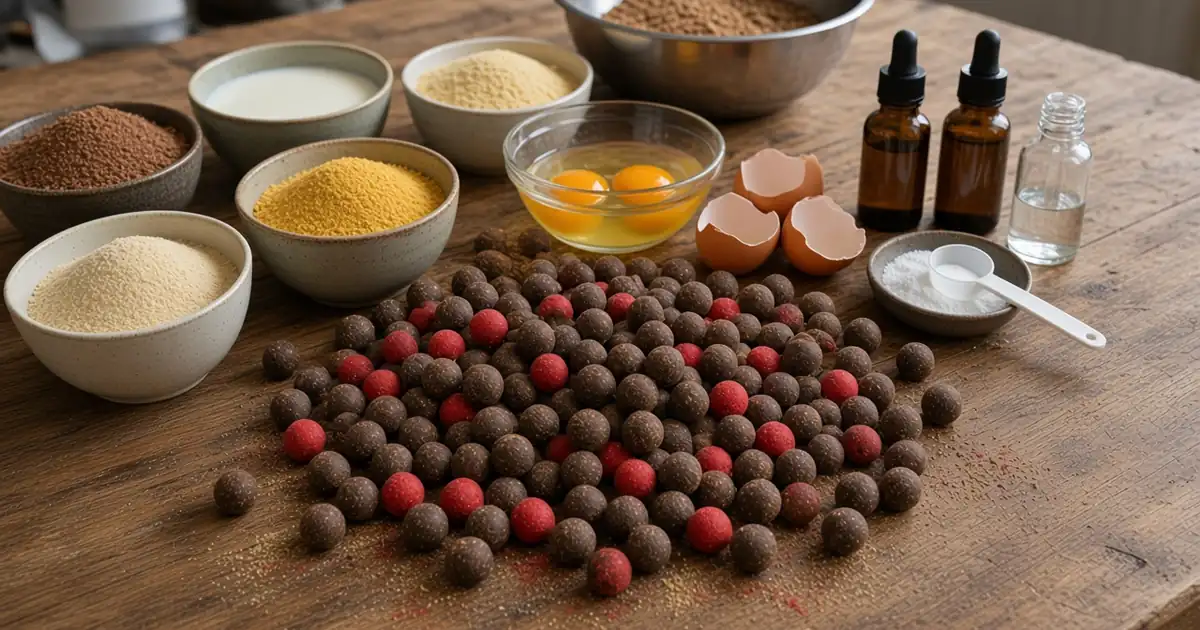
Strip any boilie recipe back and you get the same building blocks. There is a protein and food part (fishmeal, milk proteins, birdfood), a bulk part (semolina, flours, soya), a little binder (gluten or egg albumen) and a pinch of attractor. Eggs and oil are the wet side and go in on top of the 1 kg of dry mix.
Shop mixes use the same groups. The difference is that when you mix your own, you can see every ratio and change it. All the ranges below come from the BoilieFormula ingredient library and are given as a percentage of the dry mix unless stated otherwise. Treat them as where most people start, not as lab-tested limits, because the same ingredient can behave differently from one supplier to the next.
Fishmeals: the main food signal
Fishmeal is the backbone of most carp baits. It brings a lot of protein, an oily, savoury smell and a strong food signal that is at its best in warm water.
- Standard fishmeal: 10-40% of the dry mix, with 25% a common starting point.
- LT94 fishmeal: 10-35%, typically around 20%. It is a higher grade, low-temperature dried meal and costs more.
Push fishmeal much past 40% and the paste gets harder to roll, and the rest of the mix has to work harder to keep it together. Above about 50% you are mostly buying problems. In very cold water many anglers drop the fishmeal level and lighten the whole bait.
Milk proteins: creamy, sweet and binding
Milk proteins give a creamy, slightly sweet signal and change the texture more than you might expect.
- Skimmed milk powder: 3-15%. Very soluble and easy to find.
- Calcium caseinate: 3-15%. It firms the bait up and helps it bind.
- Sweet whey powder: 2-15%. It dissolves fast and leaks attraction into the water around the bait.
The downside is texture. Use a lot of milk protein, whey in particular, and the paste turns sticky and the boiled baits come out soft and rubbery. Keep the total milk content modest until you know how your batch behaves.
Birdfoods: texture and an easy start
Egg-biscuit birdfood is usually used at 5-30%, with 15% a good place to start. It gives the bait an open texture, a sweet, eggy flavour and some natural attraction of its own.
Birdfood is forgiving, which is why it shows up in so many first recipes. It rolls well, it breaks down steadily and a few percent either way rarely ruins a batch.
Semolina, maize meal and soya flour: the bulk of the mix
These are the fillers, but they do far more than pad the bag out. They bring carbohydrate and bulk, help bind the paste and bring the cost per kilo down.
- Semolina: 10-35%, typically around 22.5%. It rolls nicely and boils into a firm, smooth skin.
- Maize meal: 5-30%. A cheap, slightly coarse filler with a mild sweet taste.
- Defatted soya flour: 5-30%. Cheap protein (around 50% in the ingredient library) with very little fat.
If a mix cracks or falls apart, it often has too little of this group or too much coarse, oily food. If it is dense and heavy, try swapping a little semolina for birdfood.
Gluten and egg albumen: binders for a harder skin
Binders decide how tough the boiled bait is and how long it lasts against bream, roach and crayfish.
- Wheat gluten: 2-10%.
- Egg albumen powder: 1-7%.
A little goes a long way. A couple of percent of gluten tightens up a crumbly paste. Go heavy on both and you get baits that go rock hard and take an age to break down. For long soaks on a water full of nuisance fish, nudge the binder up a percent or two rather than doubling it.
Eggs and oil: the wet side of the recipe
Liquids are measured per kilo of dry mix and sit on top of it, so they do not count towards the 100%.
- Whole hen eggs: 7-11 per kg, with 9 a typical number.
- Vegetable oil: 5-30 ml/kg.
- Salmon oil: 5-20 ml/kg.
Eggs are the main liquid and the main binder in one. They set during boiling and lock the dry mix together. Egg size varies, so crack them into a bowl and keep one or two back until you see how the paste feels.
Oil adds a food signal and makes the paste smoother. In cold water use much less, or none at all. Our guide to winter boilies explains why.
Betaine and liver powder: attractors you weigh carefully
Attractors are highly soluble feeding triggers that you add in small amounts.
- Betaine: 1-5 g per kg of dry mix, with 2 g/kg a typical dose.
- Liver powder: 1-7% of the dry mix.
Warning: g/kg and % are not the same thing. 2 g/kg of betaine is 2 g in 1,000 g, which is 0.2%. If you read it as 2% you would add 20 g, ten times the dose. Weigh betaine on scales that read single grams.
Base mix ingredients at a glance
Here is everything above in one table. Use it as a starting sheet, not a rulebook.
| Group | Ingredient | Usual range | Typical start | Main job |
|---|---|---|---|---|
| Fishmeals | Standard fishmeal | 10-40% | 25% | Protein and savoury food signal |
| Fishmeals | LT94 fishmeal | 10-35% | 20% | Higher grade fish protein |
| Milk proteins | Skimmed milk powder, calcium caseinate | 3-15% each | 7.5% | Creamy signal, caseinate firms the bait |
| Milk proteins | Sweet whey powder | 2-15% | 5% | Soluble, leaks attraction |
| Birdfoods | Egg-biscuit birdfood | 5-30% | 15% | Open texture, sweet eggy flavour |
| Bulk | Semolina | 10-35% | 22.5% | Rolls and boils well |
| Bulk | Maize meal, defatted soya flour | 5-30% each | 15% | Cheap bulk, soya adds protein |
| Binders | Wheat gluten | 2-10% | 6% | Harder skin |
| Binders | Egg albumen powder | 1-7% | 3.5% | Toughness against nuisance fish |
| Liquids | Whole hen eggs | 7-11 per kg | 9 | Main liquid and binder |
| Liquids | Vegetable oil | 5-30 ml/kg | 15 ml | Food signal, smoother paste |
| Liquids | Salmon oil | 5-20 ml/kg | 10 ml | Oily fish signal |
| Attractors | Betaine | 1-5 g/kg | 2 g (0.2%) | Feeding trigger |
| Attractors | Liver powder | 1-7% | 3.5% | Savoury, soluble signal |
How to balance a boilie base mix
A simple way to think about balance is this: roughly 40-50% protein and food ingredients, 40-50% bulk, 2-5% binder, and attractors in small doses on top. It is a rough guide. Plenty of good baits sit a little outside it.
Here is a 1 kg test mix built that way. It is a starting point for your own experiments, not a proven recipe.
| Ingredient | Amount (g) | Percentage | Purpose |
|---|---|---|---|
| Standard fishmeal | 300 | 30% | Main protein and food signal |
| Semolina | 200 | 20% | Bulk, rolling and a firm skin |
| Egg-biscuit birdfood | 150 | 15% | Texture and sweet eggy flavour |
| Defatted soya flour | 150 | 15% | Cheap bulk with extra protein |
| Maize meal | 100 | 10% | Cheap bulk |
| Skimmed milk powder | 75 | 7.5% | Soluble, creamy signal |
| Wheat gluten | 25 | 2.5% | Binder |
| Total dry mix | 1,000 | 100% |
On top of the dry mix: about 9 eggs, 10-15 ml of oil and 2 g of betaine.
Every ingredient sits inside its usual range. The food side (fishmeal, birdfood and milk powder) comes to 52.5%, a touch above the rough split, which is normal for a fishmeal bait. Semolina, maize and soya make up 45%, and the gluten is 2.5%. Soya is counted as bulk here even though it brings protein too.
If you would rather start from a ready-made recipe, load the Basic Fishmeal Mix template into the calculator and change it from there. It is free to use.
When you adjust a mix, work like this:
- Write down the recipe as it is, with grams and percentages.
- Pick one thing you want to change, such as a harder skin or a creamier smell.
- Change one ingredient by a small amount, say 25-50 g, and take the same weight out of a bulk ingredient so the total stays at 1,000 g.
- Roll and boil a small test batch of 200-300 g.
- Note how it rolled, how hard it boiled and how it held up in water, then decide on the next change.
New to rolling your own? Start with our boilie recipe for beginners, which covers mixing, rolling and boiling step by step.
Common base mix mistakes and how to fix them
| Mistake | What happens | Fix |
|---|---|---|
| Too much milk protein | Sticky paste, soft rubbery baits | Keep the total milk content modest and swap some for semolina |
| Too much gluten or albumen | Baits go rock hard and barely break down | Stay near 2-5% binder in total |
| Mixing up % and g/kg | Ten times too much betaine | 2 g/kg is 0.2%, so weigh it in grams |
| Changing five things at once | No idea what made the difference | One change per batch, written down |
| Too much oil in winter | A heavy, greasy bait in cold water | Cut the oil right back or leave it out |
| Dry mix not adding up | Percentages that are plain wrong | Check the dry ingredients total 1,000 g and 100% |
| Buying 20 ingredients at once | Wasted money and a cupboard of half-used bags | Get good at a mix of about 6 ingredients first |
Base mix checklist
- Dry ingredients add up to exactly 1,000 g and 100%
- Each ingredient sits inside its usual range, or you know why it does not
- Binder between about 2 and 5% of the dry mix
- Betaine weighed in grams per kilo, not as a percentage
- Eggs and oil measured separately from the dry mix
- Less oil if the water is cold
- Small test batch rolled before a full kilo
- Recipe and changes written down
How BoilieFormula can help
Working out percentages, protein and cost by hand gets old fast, especially when you change one ingredient and have to redo the lot. BoilieFormula does the sums for you. The free plan gives you unlimited calculations, three saved recipes, basic warnings when an ingredient is outside its usual range, and cost per kilo using your own prices.
Pro adds unlimited saved recipes, extra recipe templates, one-click fixes and side-by-side comparison of recipe versions, which helps once you are testing changes properly. See what Pro includes if that sounds useful.
Frequently asked questions
What is the best base mix for beginners?
A simple fishmeal mix with semolina, birdfood, soya, a little milk powder and a little gluten is hard to beat. It rolls easily and forgives small mistakes. The 1 kg test mix above is a reasonable place to start.
Can I make boilies without fishmeal?
Yes. Birdfood, milk proteins and soya can carry a mix on their own, and many anglers use them in cold water or when they want a sweeter, creamier bait. Raise the birdfood and milk content and keep enough semolina for the bait to roll and boil.
How many eggs per kg of mix?
Most mixes take 7-11 medium eggs per kilo of dry mix, with 9 a common number. Dry, absorbent mixes need more and oily ones need fewer. Add the last one or two slowly until the paste is firm and no longer cracks.
Why do my boilies crack or go soft?
Cracking usually means too little binder or bulk, too few eggs or a paste that was left to dry before rolling. Soft baits are often down to too much milk protein, especially whey, or a boil that was too short. Change one thing at a time to find the cause.
Is semolina or soya better as a filler?
They do different jobs. Semolina rolls nicely and gives a firm skin, while defatted soya adds cheap protein with little fat. Many mixes use both, for example 20% semolina and 15% soya.
Final thoughts
You do not need a cupboard full of exotic powders to make good boilies. Learn what each ingredient group does, start inside the usual ranges and change one thing at a time. That way every batch teaches you something.
Put your mix into the free boilie calculator and see the percentages before you roll a single bait.