Your first homemade boilie recipe: a step-by-step guide from mix to bag
In this guide
Here is a boilie recipe you can roll on your first go: 300 g fishmeal, 250 g semolina, 200 g full-fat soya flour, 100 g skimmed milk powder, 100 g breadcrumbs and 50 g wheat gluten. That is 1 kg of dry mix. Bind it with about 10 medium eggs and 10 ml of salmon oil, roll it, boil it for around two minutes and let it dry before it goes in the bag.
Below you will find how to make boilies with this mix from start to finish: how many eggs you really need, how long to boil, how to dry and store them, and why first batches crack or fall apart. Roll it once as it is, then start changing it.
Key takeaways
- Dry mix for 1 kg: 30% fishmeal, 25% semolina, 20% full-fat soya flour, 10% milk powder, 10% breadcrumbs, 5% wheat gluten.
- This mix takes about 10 medium eggs. Crack 8 first and add the rest one by one.
- Let the paste sit for 10-15 minutes before you roll.
- Boil 15-18 mm baits for about 2 minutes, a few handfuls at a time.
- Dry them slowly at room temperature, never next to a radiator.
A simple 1 kg boilie recipe for beginners
This is the same balance as the Basic Fishmeal Mix template on BoilieFormula. It is plain on purpose. You can buy everything easily, and each ingredient has one clear job, so if a batch goes wrong it is easier to work out why.
The weights are for the dry mix only. Eggs and oil come on top of the 1 kg.
| Ingredient | Amount (g) | Percentage | Purpose |
|---|---|---|---|
| Standard fishmeal | 300 | 30% | Main protein and a natural fishy smell |
| Semolina | 250 | 25% | Binds the paste and gives a firm skin |
| Full-fat soya flour | 200 | 20% | More protein, a bit of natural oil and bulk |
| Skimmed milk powder | 100 | 10% | Milk protein and a smoother paste |
| Breadcrumbs | 100 | 10% | Opens the bait up so it breaks down and leaks more easily |
| Wheat gluten | 50 | 5% | Strong binder that also makes the bait harder |
| Total dry mix | 1,000 | 100% |
On top of the dry mix you need:
- About 10 medium eggs, roughly 520 g once cracked
- 10 ml salmon oil (about 9 g)
- A liquid flavour if you like, at the dose on the bottle
You will end up with roughly 1.5 kg of wet paste. The finished baits weigh less once they have dried out.
All six ingredients sit inside the usual ranges in the BoilieFormula ingredient library. Wheat gluten, for example, is normally kept between 2% and 10% of the dry mix, and fishmeal between 10% and 40%. That is why this mix is forgiving.
How many eggs per kilo of boilie mix?
A lot of base mixes need 5 to 8 medium eggs per kilo. This one needs more, around 10, because semolina, soya and breadcrumbs soak up plenty of liquid. Your exact number depends on your ingredients and your eggs.
A medium egg weighs 53 to 63 g in the shell, which gives you roughly 50 g of liquid egg. If your eggs are small or large, weigh them after cracking. Aiming for 520 g is more reliable than counting to 10.
The egg does two jobs. It turns the powder into a paste, and when it heats up it sets, which is what holds the boilie together. Egg white proteins start to set at around 62 °C and the main one, ovalbumin, at around 80 °C. Boiling water is well above both.
How to make boilies, step by step
- Weigh all the dry ingredients and stir them together well in a big bowl. Lumps of gluten or milk powder turn into weak spots later.
- Crack 8 eggs into a second bowl, add the salmon oil and any flavour, and whisk.
- Tip the dry mix into the eggs a few handfuls at a time and stir with a strong spoon. When it gets too stiff, carry on by hand.
- If it is still crumbly once most of the mix is in, whisk in another egg. Keep going one egg at a time until it holds together.
- Knead until it feels like firm modelling clay. It should not stick to your hands or crack when you fold it.
- Cover the bowl and leave it for 10-15 minutes. The dry stuff keeps soaking up the egg, so the paste often firms up a little. Give it a quick knead.
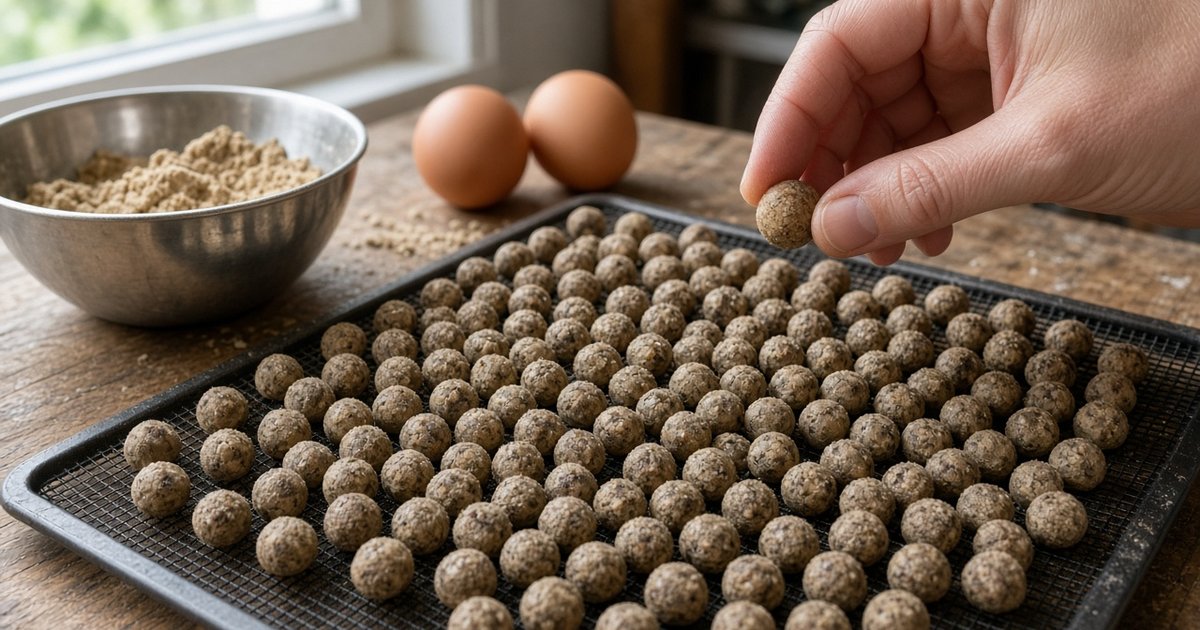
- Roll the paste into sausages, by hand on a board or with a bait gun. Cut them and roll them into balls on a rolling table, or by hand for a small batch. 15-18 mm is a good size for a first go.
Tip: If the paste sticks to the rolling table, rub a few drops of oil on it. If it is sticky all the way through, knead in a little more dry mix instead.
How long to boil boilies
For 15-18 mm baits, start with about 2 minutes in water that is boiling hard. Smaller 12-14 mm baits need around 90 seconds. Baits of 20 mm and up, or hookbaits, can take 3 minutes or more.
- Boil a couple of handfuls at a time so the water does not go off the boil.
- Start the clock when the water boils again, not when the baits go in.
- Lift them out with a slotted spoon or a chip basket and spread them out straight away.
- Once one has cooled, cut it in half. It should be firm right through, with no wet middle.
Boil longer and you get a harder skin and a bait that lasts longer in the water. Boil shorter and it stays softer and breaks down faster. When you test, change only the boiling time, so you can see what it does.
Some anglers steam their baits instead. Steaming takes longer, so cut one open to check rather than going by the clock.
Drying and storing your first batch
Spread the boiled baits out in one layer on a towel or in an air-dry bag. Leave them at room temperature where some air moves around, and turn them now and then. Keep them away from radiators, sun and fan heaters. Drying too fast is one of the main reasons boilies crack.
- Freezer baits: dry for around 24 hours until the skin feels dry, then bag and freeze. Thaw what you need before a session.
- Air-dried baits: leave them in an air-dry bag for several days and give them a shake every day, until they are hard right through. They keep longer, but they end up very hard.
- Write the recipe name and date on each bag.
Warning: Never seal warm or damp baits in a plastic bag. They sweat and go mouldy.
First-batch mistakes and how to fix them
| Problem | Likely cause | Fix |
|---|---|---|
| Baits crack while drying | Paste too dry, or dried too fast near heat | Add one more egg next time and dry at room temperature |
| Baits fall apart in the pan | Not enough binder, paste too wet, or the water stopped boiling | Keep the gluten at 5%, firm the paste with a bit more dry mix and boil fewer at once |
| Too soft after boiling | Boiled too short, or too much liquid | Boil 30-60 seconds longer and make sure the paste is firm before rolling |
| Paste sticks to the rolling table | Paste too wet | Knead in more dry mix or wipe the table with a drop of oil |
| Raw, wet middle | Baits too big for the boiling time | Roll them smaller or boil them longer |
| Mould in the bag | Bagged before they were dry, or while still warm | Dry them properly first and use breathable bags for air-dried baits |
Checklist before you start rolling
- Dry ingredients weighed, adding up to exactly 1,000 g
- Dry mix stirred well, no lumps
- About 10 eggs ready, only 8 cracked to start with
- Big pan of water on a hard boil, plus a slotted spoon or basket
- Towels or air-dry bags laid out
- Bags and a pen for labels
- Recipe and any changes written down
How BoilieFormula can help
BoilieFormula is an online boilie recipe calculator. You put in your ingredients and it works out the ratios, estimated nutrition, cost and how the mix is likely to behave. Change one ingredient and you see the difference straight away, without a notebook or a spreadsheet.
The free plan gives you unlimited recipe calculations, basic nutrition estimates, a balance score with basic warnings, cost per kg with your own prices, the ingredient library and up to 3 saved recipes. Open the Basic Fishmeal Mix in the calculator, play with it and create a free account to save it, or start from scratch in the free boilie recipe calculator.
Note: The figures are estimates worked out from ingredient data, not lab results. They are most useful for comparing one version of your mix with another.
Adjusting the recipe for your fishing goal
| Fishing goal or problem | What to consider | Recommended approach | How BoilieFormula can help |
|---|---|---|---|
| A first batch that rolls cleanly | Binding and how much egg the mix takes | Use the recipe as written and only change the number of eggs | Basic warnings flag mixes that may be hard to bind |
| Harder hookbaits that last longer | Gluten level and boiling time | Take wheat gluten up to 8-10%, cut the semolina by the same amount and boil longer | Shows whether the mix stays balanced |
| Cheaper bait per kg | Fishmeal and milk powder are often the dearest parts | Swap some fishmeal for semolina or soya and test a small batch | Cost per kg with your own prices |
| Colder water | Fat level and how fast the bait breaks down | Keep added oil low and try a shorter boil for a softer bait | Estimated fat so you can compare versions |
Frequently asked questions
How many eggs do I need for 1 kg of boilie mix?
Most base mixes take 5 to 8 medium eggs per kilo, but a mix this heavy on semolina and crumb can need around 10. Start with fewer than you think and add the rest one at a time. Weighing the liquid egg (about 50 g per medium egg) is more consistent than counting.
How long should I boil homemade boilies?
About 2 minutes for 15-18 mm baits, around 90 seconds for 12-14 mm and 3 minutes or more for 20 mm and bigger. Time it from when the water boils again. The longer you boil, the harder the bait and the slower it breaks down.
Why do my homemade boilies crack?
Usually the paste was too dry, or the baits dried too fast near heat or in the sun. Add an extra egg, knead until the paste is smooth and dry them slowly at room temperature. Badly rolled baits can also split along the seams.
Why do my boilies fall apart when boiling?
Most often there is too little binder, the paste is too wet, or you put so many baits in that the water stopped boiling. Keep a binder like wheat gluten in the mix, make sure the paste is firm and boil small batches.
How should I store homemade boilies?
For softer baits, dry them for about 24 hours and freeze them in labelled bags. For baits that keep without a freezer, air-dry them for several days until they are hard right through and store them in breathable bags. Never seal damp baits in plastic.
Can I make this recipe without fishmeal?
Yes. You can swap the fishmeal for a birdfood or for more soya and milk protein, but the binding, the egg count and the nutrition will all change. Put the new version into a recipe calculator and roll a small test batch before you make a full kilo.
Final thoughts
There is no secret to a first batch that holds together. Balance the dry mix, use enough egg, keep the water at a proper rolling boil and dry the baits slowly. Roll this recipe once as it is, note what you see, then change one thing at a time.
When you want to make it your own, build your first boilie recipe in the free calculator and see how the mix balances before you weigh out a single gram.
Sources and further reading
- British Egg Information Service: egg sizes and weights
- Gel point of whey and egg proteins using dynamic rheological data (Journal of Food Science, 1993)
- The thermodynamic and gelation properties of ovalbumin and lysozyme (PMC)
- BoilieFormula ingredient library: typical ranges and what each ingredient does